Get Two Days Free Trial

Get Accurate Research Calls

Showing posts with label financial. Show all posts

Saturday, May 27, 2017

Introducing BLUE CHIP Service For Stock Market Traders

Blue chip stock is a high-quality and high-priced stock. It gains that status from its past record of being a high growth, high dividend paying company. These companies would be leaders in its field.
The Blue Chip shares are of very large and well-recognized companies with a long history of sound financial performance.
These stocks are known to have capabilities to endure tough market conditions and give high returns in good market conditions. Blue chip stocks generally cost high, as they have good market reputation.

 Blue Chip Services


WHAT IS A BLUE CHIP COMPANY?
A Blue chip company is very strong financially, with a solid track record of producing earnings and only a moderate amount of debt. It also has a strong name in its industry with dominant products or services.

Blue chip companies have several characteristics:
• They are usually large companies.
• They are usually older companies.
• They generally sell widely used products or services.
• They perform relatively well during economic downturns.
• They have records of long-term, stable growth.
• They usually pay regular dividends, and those dividends usually grow over time.
• They have reputations as management and industry leaders.
• They are usually very creditworthy.

As per market capitalization, the leading blue chip companies of India are Tata Consultancy Services (TCS), Reliance Industries, Oil and Natural Gas Corporation Limited (ONGC), Imperial Tobacco Company of India Limited (ITC), Housing Development Finance Corporation Limited (HDFC) Bank, Coal India, Sun Pharmaceutical Industries Limited, Infosys, State Bank of India (SBI) and Industrial Credit and Investment Corporation of India Limited (ICICI) Bank.


SALIENT FEATURE OF SCHEME
• We provide1- 2 intraday stock CASH calls in blue chip stocks only.
• Each call will have Two target and one stop loss
• The quantity to be traded will be defined in calls as per levels.
• Updates on important news & information
• Proper follow up through SMS and Messenger
• Nifty Review Support & resistance
• World Market, Singapore Nifty & Other Updates
• Daily news letter with updates about market activities

Know More About Blue Chip Services


googleplus-logos-02facebook-logolinkedin-logotwitter-logo

Friday, April 14, 2017

Rupee Rebounds 26 Paise To 64.41 Against US Dollar

The rupee on Thursday staged a smart rebound and closed 26 paise higher at 64.41 against the US dollar on account of fresh selling of the American currency by exporters as also helped by weakness in greenback overseas.
In the global market, the dollar remained under pressure in early trade today, with US President Donald Trump stating that he prefers a weaker US currency, hurting investing appetite for the greenback. The rupee opened higher at 64.45 as against yesterday's closing level of 64.67 per dollar at the Interbank Foreign Exchange market here today.
TradeIndia Research Indian Rupee
Later, it advanced to 64.26 on good bouts of dollar selling from banks before ending at 64.41, showing a gain of 26 paise or 0.40 per cent.
The domestic currency hovered between 64.26 and 64.48 per dollar during the day. The RBI, meanwhile, fixed the reference rate for the dollar at 64.3165 and for the euro at 68.6193. The dollar index, which tracks the US currency against a basket of six major rivals, was trading lower by 0.45 per cent to 100.33. In cross-currency trade, the Indian unit firmed up against the pound sterling and finished at 80.71 from 80.82 per pound and advanced further against the euro to settle at 68.47 compared to 68.54 earlier.
However, it drifted against the Japanese Yen to end at 59.02 per 100 yens from 58.97 yesterday.
In an interview with Wall Street Journal, Trump said the dollar "is getting too strong" and that he would prefer if the Federal Reserve kept interest rates low.
Earn Money In Stock Trading
His comments appeared to have the desired effect, immediately sending the dollar lower, to trade around a five-month low against the yen.
In the forward market today, premium for dollar inched up on mild payments from corporates.
The benchmark six-month premium for September ended steady at 150-152 paise and the far-forward March 2018 inched up to 308-310 paise from 307.5-309.5 paise.
Meanwhile, the benchmark Sensex dropped further by 182.03 points or 0.61 per cent to close at 29,461.45.

Call On TOLL FREE Number: 18003157801

googleplus-logos-02facebook-logolinkedin-logotwitter-logo

Saturday, April 1, 2017

Top 5 Big Lessons Investors Learned in FY2017

The last 12 months for Indian market were nothing short of a roller coaster ride for investors. The Nifty50 which gave 18 per cent return in the financial year 2017 hit a low of 7,900 in December but then bounced back sharply to hit its fresh record high of 9,218.40 in March.
TradeIndia Research Financial Year 2017
It was a difficult year for traders but for investors, it gave multiple entry points which they could have used to accumulate quality stocks for long-term. For the most part of the year, the market moved in a range ahead of crucial global as well as domestic events.
Indian market managed to withstand global volatility emanating from events such as Brexit, a rate hike by US Federal Reserve and surprise win of Donald Trump in US Presidential elections back in the month of November 2016.
Back home demonetisation, muted quarterly earnings growth from India Inc., Rexit, geopolitical tensions which emerged after India’s surgical strike on PoK, political uncertainty ahead of state elections etc. all weighed on sentiments.
Although investors made money in India market if they would have held on to their long positions but there are lessons to be learned:
Market always give you entry points, don’t ignore:
This is one of the difficult questions in front of investors and advisors as to when to enter. Well, there is no specific month for that or even a season, investors have to remain patient and sit on cash and just wait.
When things look grim for markets and there is fear instead of euphoria there is your entry point. Why are entry points important? Well, simple explanation to that is – if you buy at a low price there is a higher chance of you making money in that trade.
One such entry point came back in the month of December when Nifty50 made a low of 7,894 or nearly 7,900 but then went in just one direction i.e. higher.
“What started as a pullback in December 2016 from the low of 7,894, has strengthened with a prudent general budget, impressive corporate earnings and followed with an enormous victory by BJP in state elections,” Amar Ambani, HoR at IIFL Private Wealth said. In just first three months of 2017, Nifty has recorded returns of 12 per cent.
Don’t look back, looking ahead is important:
You may not be able to recover what you lost in FY17 in markets. But, it is important to realise the possibility which FY18 presents you. Don’t remain stuck with stocks which you have already invested in, build your portfolio by adding quality stocks.
Do you know more than 100 stocks in the S&P BSE Smallcap index more than doubled your wealth in the last 12 months which includes names like Tata Metaliks, Aptech, Escorts, GNFC, Lumax Industries, ITI, Manappuram Finance, Edelweiss Financial, Gulf Oil, Delta Corp etc. among others.
In the midcap space, six stocks rose more than 100 per cent in the last 12 months which include names like Indian Bank, Bajaj Finserv, Biocon, Sun TV, JSPL, and HPCL.
The idea is not to look at the short-term market movement but be more forward looking when we are making decisions related to investments.
“Market discounted all the negative news and rose higher. The effect of falling interest rates, US Elections, Brexit, Demonetization were discounted under the long-term positives of India growth story and delivered upside returns of 18 per cent in the financial year gone by,” Dinesh Rohira, Founder CEO of 5nance told Moneycontrol.com.
“Though it is tough to think beyond a short-term, the past year has shown that regardless of some pulling down factors, markets can and will go higher,” he said.
Focus on quality and not on quantity:
We always come face to face with situations when we feel stuck. This happens when investors get stuck with stocks which are not that liquid.
Why is liquidity important? Liquidity is your way out from any stock. It means that whenever you want to cash out there are enough buyer which want to buy that stock. One big lesson for investors at any stage is to focus on stocks which have enough liquidity.
Equities remain one of the attractive destinations with better growth outlook than its major competing asset classes such as fixed income, real estate, gold etc.
“We recommend investing in quality names that have reasonable growth visibility coupled with strong balance sheets. We advise a staggered buying approach to build a long-term portfolio,” Pankaj Pandey, Head of Research, ICICI Securities told Moneycontrol.com.
You forgot to diversify:
I am sure you know this by now that diversification is very important not just in equities but across sectors and asset classes. If we closely look at the way the past 12 months have gone by, we note that it was cyclic in terms of rallies in sectors like automobiles, telecom, pharma and banking at different time frames.
“The idea is to diversify across sectors. If you did not have an exposure to some sectors, the year could have turned out to be bad. The year was a complete turn-off for gold and real estate, the assets that has the maximum wealth of the nation,” said Rohira of 5nance.
“With the interest rates for fixed income instruments floored to sub 7 per cent investors should look forward to diversify in other avenues like debt funds that ensure stability of returns and an element of safety. A diversified and balanced portfolio is a key to building wealth on a long term,” he said.
Govt policies take time to give returns, be patient:
After gaining majority win in the state elections, the ruling government is in a much better position to implement reforms and bring out policies which can fuel the growth rate in Asia’s third-largest economy.
FY18 will see the fruits of important reforms undertaken by the government in FY17 such as demonetisation and goods and services tax (GST) which are likely to benefit small and midcap stocks more than largecaps.
Investors should learn that scope of the policies which are being implemented by the government and make their own assessment as to which sector or stock (s) will benefit directly from the implementation of such policies in future.
Instead of waiting for policies to get implemented there is no harm being prompt in your approach and buy stocks which will be available at attractive valuations.

Call On TOLL FREE Number: 18003157801

googleplus-logos-02facebook-logolinkedin-logotwitter-logo

Wednesday, March 29, 2017

Stock Market Opening Gainers And Losers News With Nifty Future Updates - 29th March

TradeIndia Research is one of the best stock market Nifty Trading Tips provider in Indore who delivers tips in equity and commodity markets to the traders for profitable stock trading tips.

Stock Market Opening News

Picking up from where it previously left, the market opened on a higher note, tracking global cues and steady domestic developments around GST as well.
The 30-share BSE Sensex was up 71.07 points at 29,480.59 and the 50-share NSE Nifty rose 22.80 points to 9,123.60. About 751 shares advanced against 204 declining shares on the BSE.
Bharti Infratel, Tata Power, Axis Bank, Bharti Airtel, Tata Steel, L&T and SBI were early gainers while Wipro, Adani Ports, Reliance Industries, GAIL, Tata Motors and BPCL were losers.
The Indian rupee gained past USD 65 against the US dollar for the first time since October 28, 2015. It closed at 65.04 to the dollar in previous session.

Top Gainers
  • Bharti Infratel
  • Tata Power
  • Ambuja Cements
  • Axis Bank
  • SBI


Top Losers
  • Tech Mahindra
  • Grasim
  • Adani Ports
  • Wipro
  • Aurobindo Pharm


Nifty Future

Resistance 1 - 9088.00
Resistance 2 - 9126.00
Support 1 - 9018.00
Support 2 - 8986.00
Nifty Future And Bank Nifty Future

Bank Nifty Future

Resistance 1 - 21154.00
Resistance 2 - 21266.00
Support 1 - 20954.00
Support 2 - 20866.00


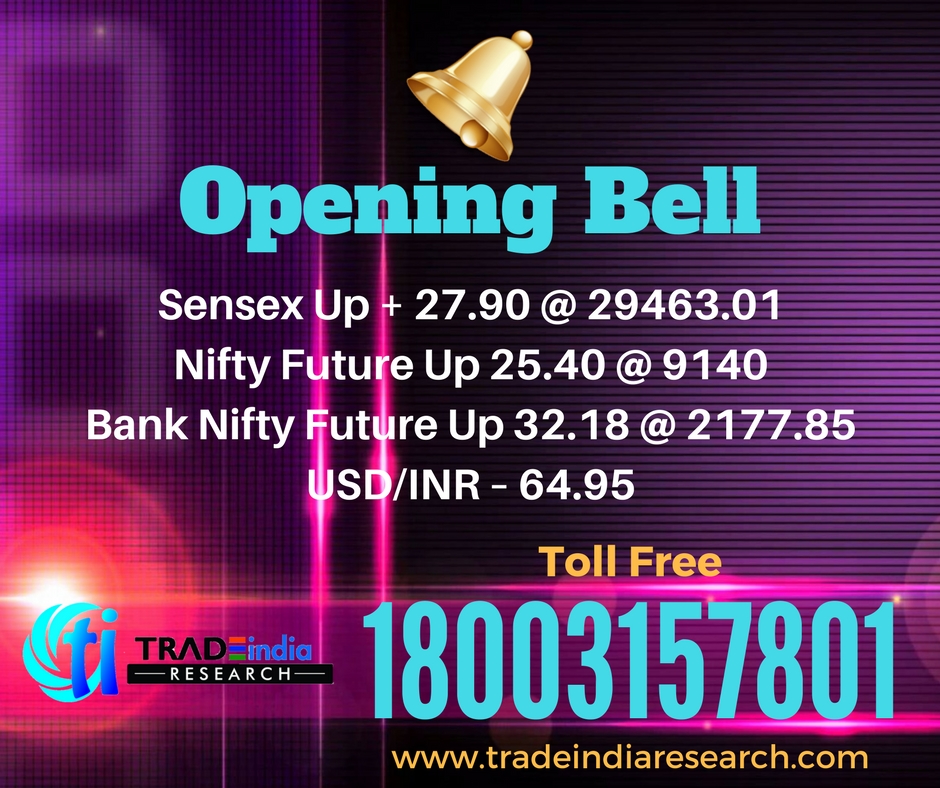
Opening Bell

TradeIndia Research Opening Bell - 29th March
Sensex Up + 27.90 @ 29463.01
Nifty Future Up 25.40 @ 9140
Bank Nifty Future Up 32.18 @ 2177.85
USD/INR – 64.95


Call On TOLL FREE Number: 18003157801

googleplus-logos-02facebook-logolinkedin-logotwitter-logo

Saturday, January 28, 2017

Investors Brace For Transaction Tax Hike, Less Friendly Budget

Investors in India are bracing for higher taxes and fewer incentives from the government's annual Budget on February 1 as the focus shifts to wringing out revenues to finance giveaways and higher public investment.
While Prime Minister Narendra Modi's administration is widely seen as being friendly to businesses and investors, it not expected to announce any dramatic moves at a time when the economy is under pressure from a cash squeeze.
knowstartup_investors1
Among expected measures are a hike in a transaction tax on stock derivatives trading and a less beneficial approach to long-term capital gains tax exemptions, according to analysts.
India is also set to provide guidelines for new rules in April that will crack down on tax havens, while foreign portfolio investors are seeking clarity behind "indirect transfer" rules that could increase tax liabilities for overseas funds.
But any negative impact from such measures could easily be offset should the government also lower corporate tax rates or provide incentives to sectors hit by government's surprise decision in November to abolish high-value banknotes, analysts said.
"We can certainly see a sensitivity for investor concerns, and the government wants to do things like ease the cost and complexities of doing business, improve India's competitiveness rankings and attract foreign investors," said Rajesh H. Gandhi, a tax partner at Deloitte Haskins & Sells.
"However, at the same time the government has revenue pressures as it seeks the meet its fiscal targets."
Expectations for higher taxes for investors have increased since Modi said in December that market participants needed to make a "fair contribution" to nation-building, without providing any details.
Among the potential measures could be a second consecutive annual hike in the Securities Transaction Tax for futures and options markets, currently set at around 0.05 percent for every 10 million trades.
India could also lower the time threshold for long-term capital gains. Currently, investments sold after at least a 12-month holding period are exempt from taxes, while anything below that is taxed at up to 20 percent of the gains.
tax
For foreign investors, the Budget is expected to provide guidelines behind the General Anti Avoidance Rule (GAAR) that will start in April, especially on whether it will take precedence over individual tax treaties such as those with Singapore or Mauritius.
Overseas portfolio investors will also seek more details after India's tax department said in December that foreign companies with more than 50 percent of their assets in India could be liable to pay indirect transfer taxes when exiting from their investments.
The comment was seen as potentially ensnaring foreign funds that have more than half of their portfolios invested in India.

Call On TOLL FREE Number: 18003157801

googleplus-logos-02facebook-logolinkedin-logotwitter-logo

Saturday, January 21, 2017

BSE Raises Rs 373 Crore From Anchor Investors

Leading stock exchange BSE today raised Rs 373 crore by allotting shares to anchor investors ahead of its much-awaited initial public offer opening on January 23.
The exchange has allotted shares to anchor investors at the price of Rs 806 apiece, the higher end of its IPO price band of Rs 805-806.
Among the anchor investors are Goldman Sachs Asset Management, ICICI Prudential Mutual Fund, Kotak Mutual Fund, Citigroup, IDFC Mutual Fund, DSP Blackrock, Capital World, Reliance Capital Trustee Company and Kuwait Investment Authority Fund, according to a release.
The stock exchange aims to raise up to Rs 1,243 crore from its IPO, which is priced at Rs 805-806 per share.
The IPO opens on January 23 and closes on January 25, which will be the first by a domestic stock exchange.
bombay-stock-exchange

Get Perfect And Accurate Stock Market Trading Tips By

Stock Advisory Company


During the initial share sale -- this year's first as well -- shareholders will sell 15.43 million shares estimated to be around Rs 1,243.44 crore at the higher end of the price band.
The IPO of 15,427,197 shares of face value of Rs 2 each will constitute up to 28.26 per cent of the fully-diluted post offer issued share capital of BSE.
Bids for the issue can be made for a minimum of 18 shares and in multiples of 18 thereafter.
Among the existing shareholders are Bajaj Holdings Investment, Caldwell India Holdings, Acacia Banyan Partners, Singapore Exchange, Mauritius-based arm of American investor George Soros' Quantum Fund and foreign fund Atticus.
There are an estimated 9,000 shareholders in BSE, where originally mostly brokers held shares.
However, a host of foreign investors and domestic financial institutions have acquired shares over the years and the IPO will provide some of them an exit window to monetise their investments.
BSE shares will be listed on NSE as Sebi rules do not allow self-listing for an exchange. Capital market regulator Sebi had given its final go- ahead to the draft prospectus for the IPO on December 30.
accurate-trading-tips
Get Accurate Stock Market Trading Tips
Meanwhile, rival NSE had filed draft papers with Sebi last month for an estimated Rs 10,000 crore IPO.
The issue is being managed by Edelweiss Financial Services, Axis Capital, Jefferies India, Nomura Financial Advisory and Securities (India) Pvt, Motilal Oswal Investment Advisors, SBI Capital Markets and SMC Capitals.
Multi Commodity Exchange of India is the only listed bourse in the country.

Call On TOLL FREE Number: 18003157801

googleplus-logos-02facebook-logolinkedin-logotwitter-logo

Location